


Plan Hose Supply Around Each Machine Build
Rubber hose suppliers can help machine builders organise repeat orders around approved specifications, assembly quantities and delivery dates. Depending on the agreed scope, supply may include finished assemblies, labelled parts and components grouped for each machine.
OEM means original equipment manufacturer. A missing hose can delay a machine that is otherwise ready for dispatch. Planning purchases alongside production helps identify incomplete requirements before assembly begins.
Why Kit Based Supply Fits Modern Manufacturing
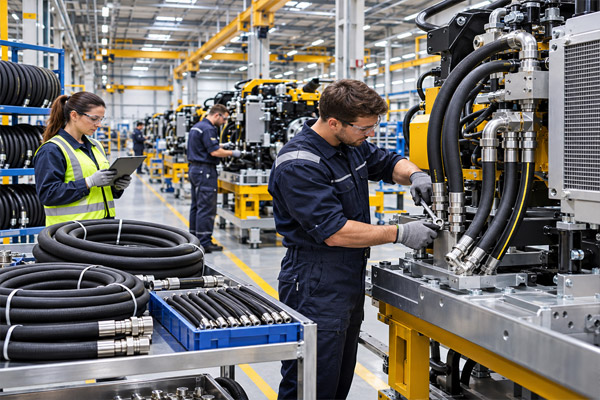
Hose kits group the approved assemblies and related components needed for a particular machine or production stage. The arrangement can reduce the sorting work required at the assembly station.
Kit supply suits repeat builds and mixed model production, provided every configuration has a clear identity.
Shared digital parts lists can help purchasing, engineering and production teams coordinate specifications and deliveries.
Build an Approved Parts List for Each Model
| Record | What It Should Identify |
| Machine model | The equipment version and applicable options |
| Hose reference | A unique part number and quantity per machine |
| Assembly drawing | Dimensions, connections and fitting orientation |
| Operating duty | Media, pressure, temperature and movement requirements |
| Revision | The approved version of the specification |
| Supply scope | Assembly, identification, packaging and documentation requirements |
Approve a Prototype Before Repeat Deliveries
A drawing review should be followed by checking a sample assembly on the intended machine. Confirm that the hose reaches its connections and follows the planned route.
Check clearance through the equipment’s expected movement. Look for contact with sharp edges, nearby heat sources or parts that could rub against the cover. Follow the manufacturer’s bend and installation requirements.
Record the accepted configuration before releasing repeat orders. Fit checks should accompany the required technical validation and testing. A prototype that installs neatly still needs a specification suitable for the operating duty.
Label Parts for the Assembly Station
Label each assembly with its agreed part number, machine reference and revision so installers can identify its position.
Agree on barcode content if your factory uses scanning. Smaller operations may need only a clear printed label.
Include a packing list that matches the approved kit. Receiving staff should be able to check quantities and identify missing items before releasing the package to production.
Schedule Deliveries by Complete Machine Sets
Translate the production forecast into complete sets of components. For example, if each machine needs four different hose assemblies, ten machines require ten of each approved assembly.
Receiving forty hoses in the wrong mix can still leave machines unfinished. Review order completeness by machine requirement as well as total quantity.
Agree on delivery batches, required dates and the process for reporting shortages. Confirm lead times for specialist fittings or less common hose formats before promising a machine dispatch date to your customer.
Control Design Changes Across Repeat Orders
Machine designs can change after prototype approval, affecting connections, optional attachments or operating conditions.
Update the drawing and parts list together. Tell the supplier which revision applies to the next delivery and how existing stock should be handled.
Avoid allowing old and new configurations to share an unclear description. Engineering approval should also cover proposed substitutions so purchasing and production work from the same requirement.
Conclusion
A dependable OEM hose supply plan connects approved designs with complete orders and realistic delivery schedules. Prototype approval, clear labels and controlled revisions help keep repeat machine builds consistent. Hoses Market by Flexaflex Hoses International supplies industrial hose products from Ahmedabad, Gujarat, for requirements across India. Send your machine parts list, hose specifications and production quantities to discuss available products and supply arrangements.
Buyer Intent FAQs
Contact Hoses Market by Flexaflex Hoses International with your machine application, hose specifications and quantities. Confirm product availability, documentation and delivery arrangements before ordering.
Ask the supplier whether assembly services are available for your specification. Confirm finished dimensions, connections, component compatibility, inspection scope and the condition in which items will arrive.
Discuss machine-wise packing or kit supply before requesting a quotation. Provide the approved parts list, quantities per machine and identification details, then confirm the supplier’s available scope.
Send the machine reference, approved drawings, hose specifications, fittings, quantities per machine, expected production volume and delivery schedule. Include labelling, packaging and documentation requirements.
A sample can help verify installation and routing before repeat supply. Complete the required engineering checks and record the approved drawing revision before releasing the larger order.
Only where the engineering requirements allow it. Check operating conditions, routing and connection details for every application before approving a shared part number.
Issue the updated drawing and parts list with a clear revision reference. Confirm which deliveries use the new version and agree how earlier stock will be identified and handled.