


Why Hose Performance Depends on System Design Not Only Material
Industrial plants are becoming more focused on uptime, process safety, and reducing avoidable maintenance. In this environment, a flexible hose should not be treated as a simple connector between two pipes.
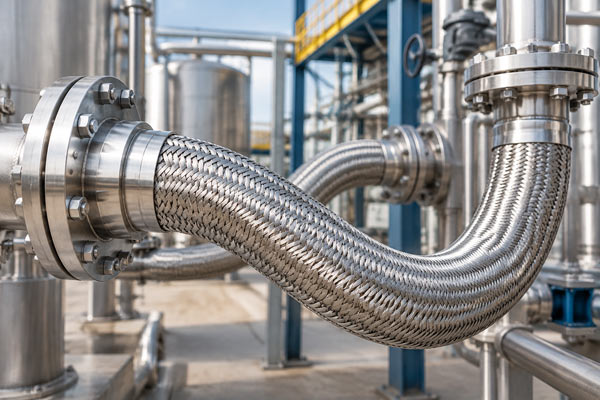
Corrugated Flexible Metal Hoses perform best when their size, braid, end fittings, bend radius, movement, pressure, temperature, and installation position are considered together. A premium stainless steel hose can still have a shorter service life when installed with excessive bending, twisting, or uncontrolled vibration.
For maintenance teams and plant buyers, the better question is no longer simply which hose is strongest. It is which hose assembly matches the actual piping conditions.
Thermal Cycling Can Change the Way a Hose Works
Industrial piping often heats up during operation and cools after shutdown. This repeated temperature change can cause pipes and connected equipment to expand and contract.
A flexible metal hose can help accommodate controlled movement, but the hose must have enough usable length and suitable geometry for the expected motion.
A hose installed too tightly between two fixed points may experience unnecessary stress during thermal movement. Buyers should therefore discuss whether the application involves static installation, occasional movement, repeated flexing, or thermal expansion.
Hoses Market lists annular corrugated stainless steel flexible hoses for industrial applications and provides minimum bend radius data for different hose sizes.
Vibration Should Be Managed Before It Becomes Fatigue
Pumps, compressors, engines, and rotating equipment can transfer vibration into connected piping.
Flexible metal hoses are often used near such equipment because they can help isolate movement. However, simply adding a short flexible connection does not automatically solve every vibration problem.
The assembly should be positioned so that the hose bends in its intended direction rather than twisting. Excessive vibration close to the welded end fitting can also place repeated stress on one area.
When requesting a hose, explain the equipment type and whether the hose will experience continuous vibration, occasional movement, or a mainly static installation.
That information can be more useful than ordering only by diameter.
Braid Selection Is About Pressure Control
The stainless steel braid surrounding a corrugated hose is not just a protective outer layer. It helps restrain the corrugated core when internal pressure acts on the hose.
Depending on the application, assemblies may use an unbraided configuration, single braid, or additional reinforcement. Hoses Market publishes different working-pressure values for unbraided, single-braid, and double-braid configurations across its flexible metal hose range.
This is why buyers should provide actual working pressure rather than simply requesting a heavy duty hose.
More reinforcement is not a substitute for proper engineering and correct application data.
End Connections Deserve More Attention
A hose assembly interacts with the piping system through its end fittings. Incorrect fitting selection can create installation difficulty even when the hose itself is suitable.
Depending on the system, connections may include threaded ends, welded connections, or flanges. Hoses Market lists these connection options for its flexible metal hose range.
Before ordering, buyers should confirm:
- Connection type
- Connection size
- Flange standard when applicable
- Overall assembly length
- Orientation of fittings
- Material compatibility
- Installation space
For customised assemblies, providing a drawing or an existing sample can reduce misunderstandings.
What Buyers Should Share Before Asking for a Quote
For Corrugated Flexible Metal Hoses, a useful enquiry should contain more than size and quantity.
Share:
- Hose bore or nominal size
- Required assembly length
- Working pressure
- Operating temperature
- Fluid or gas being transferred
- Static or flexing application
- Vibration conditions
- Required end connections
- Required braid configuration
- Quantity
- Delivery location
Hoses Market supplies stainless steel corrugated hoses and industrial hose market in Ahmedabad, Gujarat, with products available for industries including chemical, pharmaceutical, food, plastic processing, and other industrial applications.
Bend Radius Should Be Treated as an Operating Limit
One common mistake is selecting a flexible hose and then forcing it into a space that is too small.
Every corrugated hose configuration has a minimum bend radius. Bending tighter than the recommended limit can concentrate stress in the corrugations and reduce service life.
The required bend radius can also differ between a hose that remains in a fixed bend and one that flexes repeatedly. Hoses Market’s published specifications distinguish between static and flexing bend-radius requirements.
Plant designers should therefore allow enough physical space around the assembly rather than treating flexibility as unlimited.
Build Inspection Into the Hose Lifecycle
Modern maintenance is increasingly focused on preventing unplanned shutdowns rather than waiting for a component to fail.
Flexible hose assemblies should be included in routine plant inspection. Maintenance teams can look for visible braid damage, abnormal deformation, corrosion, leakage, rubbing, or changes in the installed position.
Inspection frequency should reflect the severity of the application. A hose exposed to continuous movement, vibration, high temperature, corrosive media, or demanding pressure conditions may require closer attention than a lightly loaded static connection.
Keeping records of installation date, application, operating conditions, and previous inspection findings can also support better replacement planning.
Conclusion
Corrugated Flexible Metal Hoses can play an important role in reliable industrial piping, but performance depends on how well the assembly matches the system.
Pressure, temperature, movement, vibration, bend radius, braid, fittings, and installation geometry should all be considered before ordering. Maintenance planning should continue after installation so visible changes can be identified early.
For industries in Ahmedabad, Gujarat, and across India, Hoses Market can assist with stainless steel corrugated flexible hose requirements based on actual operating conditions. Share your hose size, media, pressure, temperature, fittings, and quantity to request a suitable product recommendation and quotation.
Frequently Asked Questions
Start with hose size, media, operating temperature, working pressure, movement type, bend radius, required end connections, and installation conditions rather than choosing only by price.
Braid is commonly used when the hose assembly needs additional pressure restraint. The required configuration should be selected according to the hose size, working pressure, and application.
Provide nominal bore, assembly length, pressure, temperature, media, end fittings, braid requirement, movement conditions, quantity, and delivery location.
They can be used in piping systems where controlled flexibility and vibration isolation are required, but correct hose length, orientation, bend radius, and installation are important.
The minimum bend radius helps prevent excessive stress in the corrugated section. The required value can differ between static and repeatedly flexing applications.
Hoses Market lists threaded ends, welded connections, and flanges according to customer specifications for its flexible metal hose range.
Hoses Market by Flexaflex Hoses International supplies stainless steel corrugated and flexible metal hoses from Ahmedabad, Gujarat. Buyers can share their operating requirements and quantity for product selection and quotation.