


Why Hose Selection Now Affects Air Efficiency and Uptime
Compressed air may look simple, but every hose, fitting, bend, connection, and pressure drop affects how efficiently a pneumatic system performs. As factories move toward faster automation and more closely controlled production, buyers are paying greater attention to the complete air distribution path rather than selecting a hose only by diameter and price.
This changes what businesses should expect from Pneumatic Hose Manufacturers. Buyers increasingly need product guidance based on pressure, movement, machine layout, temperature, fittings, and actual operating conditions.
A correctly selected hose can support reliable air delivery while poor selection may contribute to leakage, pressure loss, premature replacement, and unnecessary downtime.
Smaller Is Not Always Better for Pneumatic Lines
Compact tubing can make a machine layout look neat, but an undersized air line can restrict airflow.
When a cylinder, pneumatic tool, or actuator needs air quickly, the hose must provide enough flow without creating excessive pressure loss. Long hose runs can make this issue more noticeable.
Instead of choosing pneumatic tubing only according to the connection size, buyers should consider:
- Required air flow
- Hose internal diameter
- Total hose length
- Operating pressure
- Machine cycle frequency
- Number of bends
- Valve and fitting sizes
The goal is not simply to install the largest hose possible. The hose should be appropriately sized for the actual pneumatic circuit.
Leak Control Starts at the Hose and Fitting Connection
Compressed air leakage can increase operating costs and reduce system performance. The U.S. Department of Energy includes minimizing compressed-air leaks among its recommended actions for improving system efficiency.
Leaks may occur because of damaged tubing, poor connections, unsuitable fittings, repeated movement, incorrect installation, or ageing components.
That means hose quality and fitting compatibility should be considered together.
For production teams, periodic checks around bends, fittings, machine movement points, and frequently disconnected lines can help identify problems before they cause a larger drop in air pressure.
Flexible Routing Matters in Automated Machinery
Modern machines often have limited installation space. Pneumatic lines may need to travel around frames, electrical panels, moving cylinders, robotic components, or guards.
A hose that is too rigid can be difficult to route. A hose that bends too easily may kink or become damaged if the bend radius is ignored.
Buyers should therefore think about:
Flexibility plus bend radius plus movement frequency
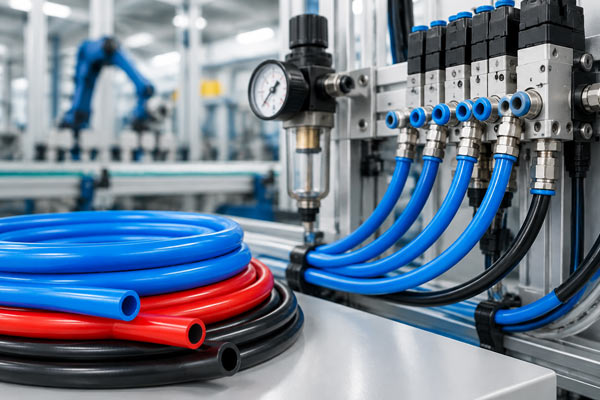
PU tubing is commonly used in pneumatic systems because it can provide flexibility for cylinders, directional control valves, solenoid valves, air preparation units, control panels, and compressed-air lines. Hoses Market lists PU and nylon tubing along with pneumatic fittings for these applications.
Material Choice Should Follow the Working Environment
There is no single pneumatic hose material that is ideal for every machine.
The correct choice depends on where the hose will operate.
For example, buyers may need to consider:
- Ambient temperature
- Oil or chemical exposure
- Outdoor conditions
- Abrasion
- Repeated flexing
- Available installation space
- Required pressure
- Required flexibility
Factories should therefore provide operating details when contacting a supplier instead of simply asking for a particular hose size.
This approach helps reduce the risk of choosing a tube that fits physically but does not suit the working environment.
Good Routing Can Extend Hose Service Life
Even a suitable pneumatic hose can fail early if installed poorly.
Avoid unnecessary twisting, excessive tension, sharp bends, contact with hot surfaces, and rubbing against machine edges. Where movement is unavoidable, the routing should allow enough flexibility for the hose to move without being stretched.
It is also useful to keep pneumatic lines organised so maintenance teams can identify individual circuits quickly.
In a busy production facility, better hose routing can make inspection, replacement, and troubleshooting easier.
Smart Factories Need Easier Maintenance
Industry discussions around pneumatics in 2026 increasingly focus on energy monitoring, diagnostics, and more efficient compressed-air use.
The hose itself may not be a digital component, but it remains an important physical part of that system.
If a factory monitors pressure or air consumption but ignores worn hoses and leaking connections, the data may reveal the problem without solving its cause.
Look for:
- Surface cuts
- Abrasion
- Cracking
- Kinking
- Loose fittings
- Air leakage
- Discolouration
- Excessive movement
- Unusual pressure drop
Replacing a worn component during planned maintenance is usually easier than stopping a machine after failure.
What Buyers Should Ask Pneumatic Hose Manufacturers
A purchasing enquiry should contain more than diameter and quantity.
Before requesting a quotation, share:
- Hose or tube size
- Required length
- Working pressure
- Operating temperature
- Application
- Required flexibility
- Machine movement
- Fitting type
- Quantity
- Delivery location
Hoses Market by Flexaflex Hoses International operates from Ahmedabad, Gujarat and supplies industrial hoses, PU tubes, pneumatic fittings, valves, cylinders, and related products for industrial applications.
For buyers in Ahmedabad, Gujarat, and other parts of India, providing complete operating details can help the supplier suggest a more suitable pneumatic solution.
Conclusion
Choosing Pneumatic Hose Manufacturers should not be based only on hose price or outside diameter. In modern compressed-air systems, airflow, pressure loss, fittings, routing, material, flexibility, and maintenance all influence performance.
As industrial automation becomes more efficiency focused, buyers should treat pneumatic hoses as part of the complete air system.
For pneumatic tubing, fittings, and industrial hose requirements in Ahmedabad, Gujarat, or across India, contact Hoses Market with your size, pressure, application, quantity, and operating conditions to discuss a suitable option.
Frequently Asked Questions
Compare product range, technical guidance, available sizes, pressure suitability, fitting compatibility, material options, supply capability, and support for your actual industrial application.
Share the hose size, working pressure, operating temperature, required length, application, movement conditions, fitting type, quantity, and delivery location.
The suitable material depends on pressure, flexibility, temperature, abrasion, movement, and operating environment. PU and nylon tubing are commonly used for different pneumatic applications.
Yes. An undersized or unnecessarily long pneumatic line can restrict airflow and contribute to pressure loss, especially when equipment requires rapid air delivery.
It is useful to check hose and fitting compatibility together because connection quality can influence sealing, installation, and reliable compressed-air performance.
Hoses Market by Flexaflex Hoses International supplies pneumatic and industrial hose products from Ahmedabad, Gujarat, along with PU tubing and pneumatic fittings.
Hoses Market accepts industrial hose enquiries from Ahmedabad, other locations across Gujarat, and customers in other parts of India depending on the required specification and availability.