


What Makes an Industrial Rubber Hose Suitable for Heavy Duty Use
Industrial operations are changing quickly, and rubber hoses are becoming more important across manufacturing, construction, agriculture, mining and transport. They carry water, air, oil, chemicals, steam, slurry and fuel under different pressure and temperature conditions. Today, buyers expect longer life, safe performance, better material compatibility and faster supply support.
Rubber hose manufacturers are responding with application-based designs, stronger reinforcement and improved testing. The publication of ISO 1436 in 2026 for wire-braid-reinforced hydraulic hoses also reflects the focus on dependable performance and safer fluid transfer.
Rubber Hose Manufacturers Are Moving Beyond Standard Products
Earlier, many buyers selected hoses mainly by diameter and pressure. Modern industries now consider temperature, transferred media, bend radius, movement, abrasion, weather exposure and pressure surges. This encourages manufacturers to design hoses for specific operating conditions.
A compressed air hose cannot be selected like a hose carrying chemicals or hot water. Its inner tube, reinforcement, outer cover and fittings must work as one assembly. Correct matching helps reduce leakage and unexpected downtime.
Sustainable Design and Longer Hose Life
Sustainability is becoming a practical purchasing factor. Companies prefer products that last longer, need fewer replacements and create less waste. Manufacturers are therefore focusing on stronger covers, improved ageing resistance and designs that can handle repeated bending.
Longer hose life can reduce disposal, maintenance work and replacement costs. Correct storage, installation and inspection can also extend useful hose life.
Smarter Monitoring for Safer Operations
Predictive maintenance is a major industrial trend. Connected sensors and data analysis are increasingly used to identify equipment problems before failure. In critical hose systems, monitoring can support pressure tracking, temperature checks, leakage detection and planned replacement. Smart manufacturing research also highlights advanced sensing, data analytics and sustainable manufacturing as growing industrial areas.
Not every hose needs a sensor. A regular inspection schedule can still help teams identify swelling, hardening, cuts, abrasion, loose fittings or unusual movement before a serious problem develops.
Application Specific Hose Engineering
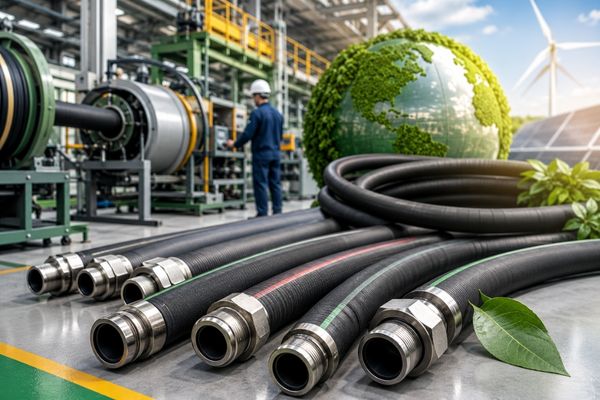
Demand is growing for hoses designed around a clear purpose. Common needs include oil resistance, chemical resistance, weather resistance, high-temperature performance, suction capability and abrasion protection. Reinforcement may use textile layers, wire braiding or spiral construction.
Rubber hose manufacturers may also offer custom lengths, colour identification, end fittings and assembly support. These options are useful for machinery builders, process plants and maintenance teams. A properly engineered hose assembly reduces the risk of mismatched components.
Safety Standards and Testing
Safety remains central to hose selection. International guidance covers correct purchasing, assembly, installation and operation. Separate standards address applications such as hydraulic fluids, water suction and discharge, industrial gases and dredging.
Quality checks may include dimensional inspection, pressure testing, burst testing, adhesion testing, flexibility checks and ageing resistance. Buyers should request test information suited to their application and confirm the rated working pressure instead of choosing a hose only by appearance.
Growing Demand for Local Supply
Industrial buyers across India often prefer suppliers that provide quick communication, technical guidance and timely replacement. Local support becomes important when a production line stops or a new machine needs a specially sized assembly.
Search terms such as rubber hose manufacturers in India, industrial rubber hose supplier near me and custom rubber hose manufacturer show local buying intent. Detailed product information, service areas and enquiry support help manufacturers build trust in regional markets.
How to Choose the Right Rubber Hose Manufacturer
Share complete application details before requesting a quotation. Mention hose size, working pressure, maximum temperature, transferred media, required length, movement and surrounding conditions. Also explain whether the hose will face sunlight, chemicals, sharp surfaces or constant bending.
Compare suppliers based on technical knowledge, material compatibility, testing, customisation and delivery support. The cheapest hose may cost more in the long run if it wears early or causes repeated downtime.
Conclusion
The industry is moving towards safer, smarter and more sustainable hose solutions. Better materials, application-based engineering, planned maintenance and stronger testing are shaping buyer decisions.
Rubber hose manufacturers that understand actual operating conditions can help industries reduce downtime, improve workplace safety and manage long-term maintenance costs. Buyers should select hoses according to their complete application requirements instead of comparing products only by price.
FAQs
They produce hoses and hose assemblies for water, air, oil, chemicals, steam, hydraulic systems, agriculture, construction and other industrial applications.
Check the required size, pressure, temperature, transferred media, flexibility, abrasion exposure, installation method and end fittings.
Yes. Reinforced rubber hoses can handle high pressure when their pressure rating, construction and fittings match the intended application.
An unsuitable inner tube may soften, swell, crack or lose strength when exposed to a particular liquid, gas, oil or chemical.
Inspection frequency depends on pressure, temperature, operating hours, surrounding conditions and safety risks. Critical hoses should follow a documented inspection schedule.
Yes. Custom options may include specific lengths, fittings, reinforcement layers, colour coding and application-specific construction.
Incorrect selection, excessive heat, pressure surges, twisting, abrasion, chemical attack, poor storage and damaged fittings are common causes.
Sustainability can be achieved through longer service life, efficient material use, lower production waste and responsible disposal practices.